Qiuchi
2025 年11 月 10 日 08:52
1
【TiDB 使用环境】生产环境
从 v6.5.0 升级至 v6.5.12,开始出现该问题
-- 其中 customer_position.pos_date 是 varchar(8),存放八位日期
explain
with cte as (
    select  '20251101' as x
)
select pos_date, cust_type
from customer_position a
where a.pos_date = (select x from cte)
id
estRows
task
access object
operator info
Projection_14
2576475.96
root
dcdb.cr_customer_position.pos_date, dcdb.cr_customer_position.cust_type
└─IndexLookUp_20
2576475.96
root
├─IndexRangeScan_18(Build)
2576475.96
cop[tikv]
table:a, index:idx_pos_date_and_code(pos_date, product_code)
range:[“20251101”,“20251101”], keep order:false
└─TableRowIDScan_19(Probe)
2576475.96
cop[tikv]
table:a
keep order:false
可以看到 cte 被折叠为 ‘20251101’,但如果再使用一次 cte,执行计划就会有问题,变成两个 HashJoin,table dual 直接被用了两次来 build 哈希表,表达式无法下推到 kv,性能大幅下降
explain
with cte as (
    select  '20251101' as x
)
select pos_date, cust_type
from cr_customer_position a
where a.pos_date = (select x from cte)
  and a.pos_date = (select x from cte);
id
estRows
task
access object
operator info
Projection_19
616.59
root
dcdb.cr_customer_position.pos_date, dcdb.cr_customer_position.cust_type
└─HashJoin_20
616.59
root
inner join, equal:[eq(dcdb.cr_customer_position.pos_date, Column#56)]
├─Selection_50(Build)
0.80
root
not(isnull(Column#56))
│ └─MaxOneRow_51
1.00
root
│ └─CTEFullScan_52
1.00
root
CTE:cte
data:CTE_0
└─IndexHashJoin_28(Probe)
3054126.67
root
inner join, inner:IndexLookUp_25, outer key:Column#55, inner key:dcdb.cr_customer_position.pos_date, equal cond:eq(Column#55, dcdb.cr_customer_position.pos_date)
├─Selection_38(Build)
0.80
root
not(isnull(Column#55))
│ └─MaxOneRow_39
1.00
root
│ └─CTEFullScan_40
1.00
root
CTE:cte
data:CTE_0
└─IndexLookUp_25(Probe)
3054126.67
root
├─Selection_24(Build)
3054126.67
cop[tikv]
not(isnull(dcdb.cr_customer_position.pos_date))
│ └─IndexRangeScan_22
3054126.67
cop[tikv]
table:a, index:idx_pos_date_and_code(pos_date, product_code)
range: decided by [eq(dcdb.cr_customer_position.pos_date, Column#55)], keep order:false
└─TableRowIDScan_23(Probe)
3054126.67
cop[tikv]
table:a
keep order:false
CTE_0
1.00
root
Non-Recursive CTE
└─Projection_17(Seed Part)
1.00
root
20251101->Column#1
└─TableDual_18
1.00
root
rows:1
但如果用 /*+ MERGE() */ 来关闭子查询物化,那么该 cte 可正常折叠
explain
with cte as (
    select /*+ MERGE() */ '20251101' as x
)
select pos_date, cust_type
from cr_customer_position a
where a.pos_date = (select x from cte)
  and a.pos_date = (select x from cte)
id
estRows
task
access object
operator info
Projection_22
2576475.96
root
dcdb.cr_customer_position.pos_date, dcdb.cr_customer_position.cust_type
└─IndexLookUp_28
2576475.96
root
├─IndexRangeScan_26(Build)
2576475.96
cop[tikv]
table:a, index:idx_pos_date_and_code(pos_date, product_code)
range:[“20251101”,“20251101”], keep order:false
└─TableRowIDScan_27(Probe)
2576475.96
cop[tikv]
table:a
keep order:false
Qiuchi
2025 年11 月 11 日 02:35
4
用 with 生成查询主体的参数不是一个很常见的写法么
explain
with cte as (
    select '20251101' as x, '20251103' as y
)
select pos_date
from dcdb.cr_customer_position a
where a.pos_date between (select x from cte) and (select y from cte)
id
estRows
task
access object
operator info
HashJoin_18
15142979470.00
root
CARTESIAN inner join, other cond:le(dcdb.cr_customer_position.pos_date, cast(Column#59, var_string(8)))
├─MaxOneRow_30(Build)
1.00
root
│ └─CTEFullScan_31
1.00
root
CTE:cte
data:CTE_0
└─HashJoin_20(Probe)
15142979470.00
root
CARTESIAN inner join, other cond:ge(dcdb.cr_customer_position.pos_date, cast(Column#56, var_string(8)))
├─MaxOneRow_28(Build)
1.00
root
│ └─CTEFullScan_29
1.00
root
CTE:cte
data:CTE_0
└─IndexReader_25(Probe)
15142979470.00
root
index:IndexFullScan_24
└─IndexFullScan_24
15142979470.00
cop[tikv]
table:a, index:idx_pos_date_and_code(pos_date, product_code)
keep order:false
CTE_0
1.00
root
Non-Recursive CTE
└─Projection_15(Seed Part)
1.00
root
20251101->Column#1, 20251103->Column#2
└─TableDual_16
1.00
root
rows:1
小龙虾爱大龙虾
2025 年11 月 11 日 02:42
5
那也没见 CTE 里就写一个标量的,一般 CTE 里都是有一定逻辑的
Qiuchi
2025 年11 月 11 日 02:46
6
标量不是说是常量,max 一个表作为参数也是一样的效果,用常量只是说想简化说明,剥离子查询的执行计划更清晰
explain
with cte as (
    select date_format(day_date, '%Y%m%d') as x
    from cr_calendar_day
    order by day_date desc
    limit 1
)
select pos_date
from dcdb.cr_customer_position a
where a.pos_date = (select x from cte)
union all
select pos_date
from dcdb.cr_customer_position_hjt a
where a.pos_date = (select x from cte)
id
estRows
task
access object
operator info
Union_37
3080578.78
root
├─IndexHashJoin_44
3054126.67
root
inner join, inner:IndexReader_41, outer key:Column#62, inner key:dcdb.cr_customer_position.pos_date, equal cond:eq(Column#62, dcdb.cr_customer_position.pos_date)
│ ├─Selection_52(Build)
0.80
root
not(isnull(Column#62))
│ │ └─MaxOneRow_53
1.00
root
│ │ └─CTEFullScan_54
1.00
root
CTE:cte
data:CTE_0
│ └─IndexReader_41(Probe)
3054126.67
root
index:Selection_40
│ └─Selection_40
3054126.67
cop[tikv]
not(isnull(dcdb.cr_customer_position.pos_date))
│ └─IndexRangeScan_39
3054126.67
cop[tikv]
table:a, index:idx_pos_date_and_code(pos_date, product_code)
range: decided by [eq(dcdb.cr_customer_position.pos_date, Column#62)], keep order:false
└─IndexHashJoin_65
26452.11
root
inner join, inner:IndexReader_62, outer key:Column#109, inner key:dcdb.cr_customer_position_hjt.pos_date, equal cond:eq(Column#109, dcdb.cr_customer_position_hjt.pos_date)
├─Selection_73(Build)
0.80
root
not(isnull(Column#109))
│ └─MaxOneRow_74
1.00
root
│ └─CTEFullScan_75
1.00
root
CTE:cte
data:CTE_0
└─IndexReader_62(Probe)
26452.11
root
index:Selection_61
└─Selection_61
26452.11
cop[tikv]
not(isnull(dcdb.cr_customer_position_hjt.pos_date))
└─IndexRangeScan_60
26452.11
cop[tikv]
table:a, index:idx_cust_pos_data_code_no(pos_date, ta_system_code, ta_account_no)
range: decided by [eq(dcdb.cr_customer_position_hjt.pos_date, Column#109)], keep order:false
CTE_0
1.00
root
Non-Recursive CTE
└─Projection_28(Seed Part)
1.00
root
date_format(dcdb.cr_calendar_day.day_date, %Y%m%d)->Column#8
└─TopN_29
1.00
root
dcdb.cr_calendar_day.day_date:desc, offset:0, count:1
└─TableReader_36
1.00
root
data:TopN_35
└─TopN_35
1.00
cop[tikv]
dcdb.cr_calendar_day.day_date:desc, offset:0, count:1
└─TableFullScan_34
5844.00
cop[tikv]
table:cr_calendar_day
keep order:false
小龙虾爱大龙虾
2025 年11 月 11 日 02:54
7
master ← elsa0520:default_inline_cte
已打开 04:22AM - 14 Sep 22 UTC
### What problem does this PR solve?
This pr mainly does an optimization of i… nline CTE.
When there is only one consumer of CTE, the CTE is inlined by default. (Except recursive CTE )
Issue Number: close #36295
Problem Summary:
### What is changed and how it works?
There are two changes:
1. Added the count processing of CTE consumers in AST perprocessor.
2. When the AST is converted into a logical plan, inline processing is performed for the CTE whose count is 1.
### Check List
Tests
- [x] Unit test
- [ ] Integration test
- [ ] Manual test (add detailed scripts or steps below)
- [ ] No code
Side effects
- [ ] Performance regression: Consumes more CPU
- [ ] Performance regression: Consumes more Memory
- [ ] Breaking backward compatibility
Documentation
- [ ] Affects user behaviors
- [ ] Contains syntax changes
- [ ] Contains variable changes
- [ ] Contains experimental features
- [ ] Changes MySQL compatibility
### Release note
Please refer to [Release Notes Language Style Guide](https://pingcap.github.io/tidb-dev-guide/contribute-to-tidb/release-notes-style-guide.html) to write a quality release note.
```release-note
None
```
cte 只被引用一次,会被自动 inline,这是从 v6.4 引入的invalid memory address or nil pointer dereference in `memory.(*Tracker).AttachTo` · Issue #55881 · pingcap/tidb · GitHub
建议你还是从应用去修改下 SQL 绕过吧
2 个赞
Qiuchi
2025 年11 月 11 日 02:57
8
比较头疼反正是,我在 6.5.0 上测了是没这个问题的,有多少次他都会折叠,现在我们生产只能挨个看哪个慢的离谱了然后加 hint 或者改 sql
程序猿_DBA
2025 年11 月 11 日 03:00
9
cte 只被引用一次,会被自动 inline,这是从 v6.4 引入的
程序猿_DBA
2025 年11 月 11 日 03:01
10
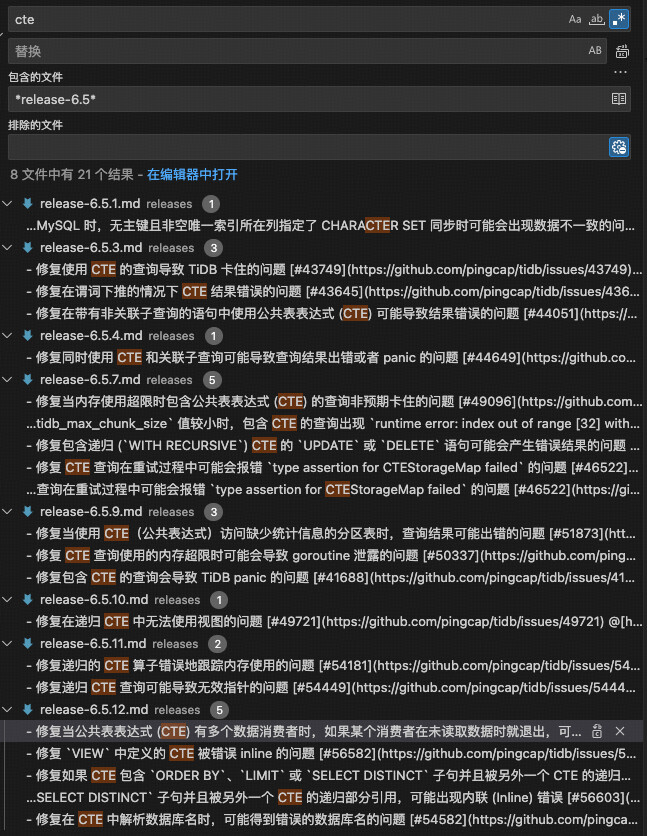
cte 相关的改动在 v6.5 版本也比较多,具体不知道那个导致你这种情况的,猜测可能跟这个有关 引用
Qiuchi
2025 年11 月 11 日 03:04
14
以这个为例,而且这个问题随着查询复杂度猛涨,如果有多个 hashjoin 用多次 cte 的话,那有几次他就要加几层
Qiuchi
2025 年11 月 11 日 06:02
17
如果 cte 是个有好多行的表的话他这个执行计划其实合理,物化 cte 在内存里应该也就基本是临时表了吧,但对于我这类使用方式来说就不合理
a.pos_date = (select x from cte)
对,我感觉在后续版本(如 v7.0+)中,这类问题通常会得到修复